Imagine a guest sitting down after a long walk through the city. They are hungry, curious about the place, and ready to understand what is worth ordering. They open the menu on their phone and switch it to Spanish.
At first, menu translation sounds simple: take the original text and convert it into another language. But food rarely works that way. A dish name can be local. A description can hint at a cooking method. A few words can change meaning depending on whether they describe a starter, a dessert, a sauce, or a house special.
This is where context starts
In AI, context means the extra information that helps the model understand what a request really means. It is not only about the words. It is about the situation around the words.
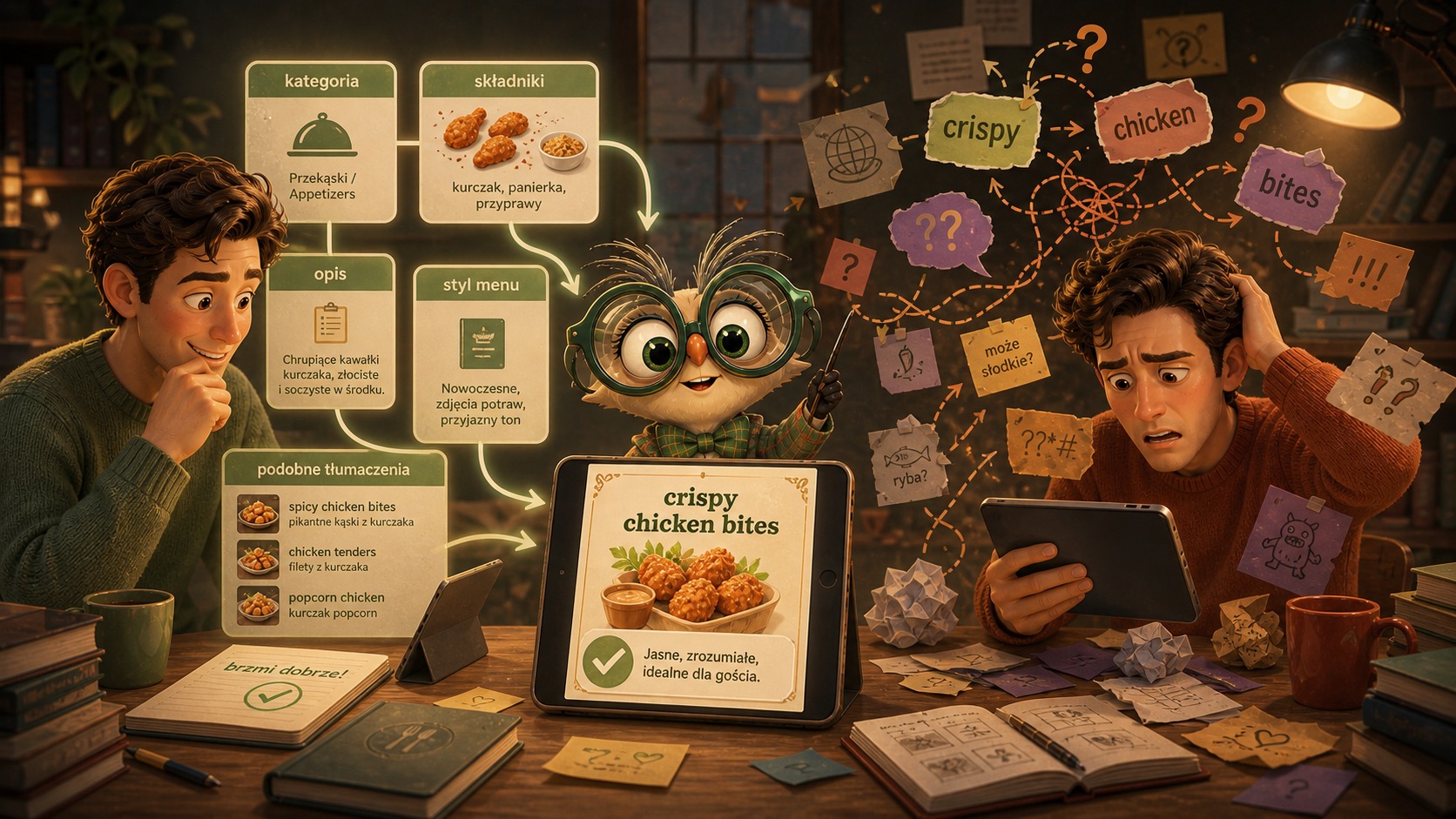
For ForkTable, that context can include the menu category, ingredients, item description, restaurant type, menu style, and previous translations of similar items. So AI does not read crispy chicken bites as three separate words. It understands that this is a menu item being read by a real guest who is trying to decide whether they want to order it.
The reference image captures the difference well: on the left, translation with context connects the clues into something useful. On the right, translation without context turns into questions, confusion, and guesswork.
Why literal translation is not enough
A menu is part of the restaurant experience. Guests do not want to decode a translation. They want to understand the dish: whether it is light, spicy, classic, local, child-friendly, good for sharing, seasonal, or vegan.
That is why good menu translation has to preserve meaning, not just wording. Sometimes that means translating a name more naturally. Sometimes it means clarifying an ingredient. Sometimes it means keeping the original name and explaining it in the description. AI can help, but only when it has enough context to work with.
But what about AI costs?
This question matters because AI uses tokens, and tokens create cost. The simplest technical approach would also be the least practical one: translate every menu into every supported language before anyone asks for it.
ForkTable takes a different approach. We do not translate everything in advance.
If a restaurant has an English menu and no guest ever opens it in Spanish, we do not spend tokens translating it into Spanish. When a guest actually chooses Spanish, ForkTable creates the translation using the right menu context.
Translate once, reuse the value
After the translation is created, we store it. If another guest asks for the same language version later, ForkTable can reuse the saved result instead of asking AI to do the same work again.
In practice, the first real guest creates the need, and future guests benefit from the saved value. The restaurant does not pay for translations nobody reads, and AI costs grow with real usage instead of the theoretical number of supported languages.
Lower cost and less wasted compute
This approach makes costs more predictable, but it also matters for another reason: it is more resource conscious. AI requires computing power. When we generate translations that nobody ever opens, we waste money and energy.
ForkTable uses AI where there is a real guest need. It translates with context, stores the result, and avoids repeating the same work without a reason.
The result for restaurants and guests
For restaurants, this means multilingual menus without unpredictable AI spending. For guests, it means translations that feel natural and help them order with more confidence.
Because a good menu is not only about language. It is about understanding. ForkTable uses AI so a guest from any country can feel that the menu was written for them too.