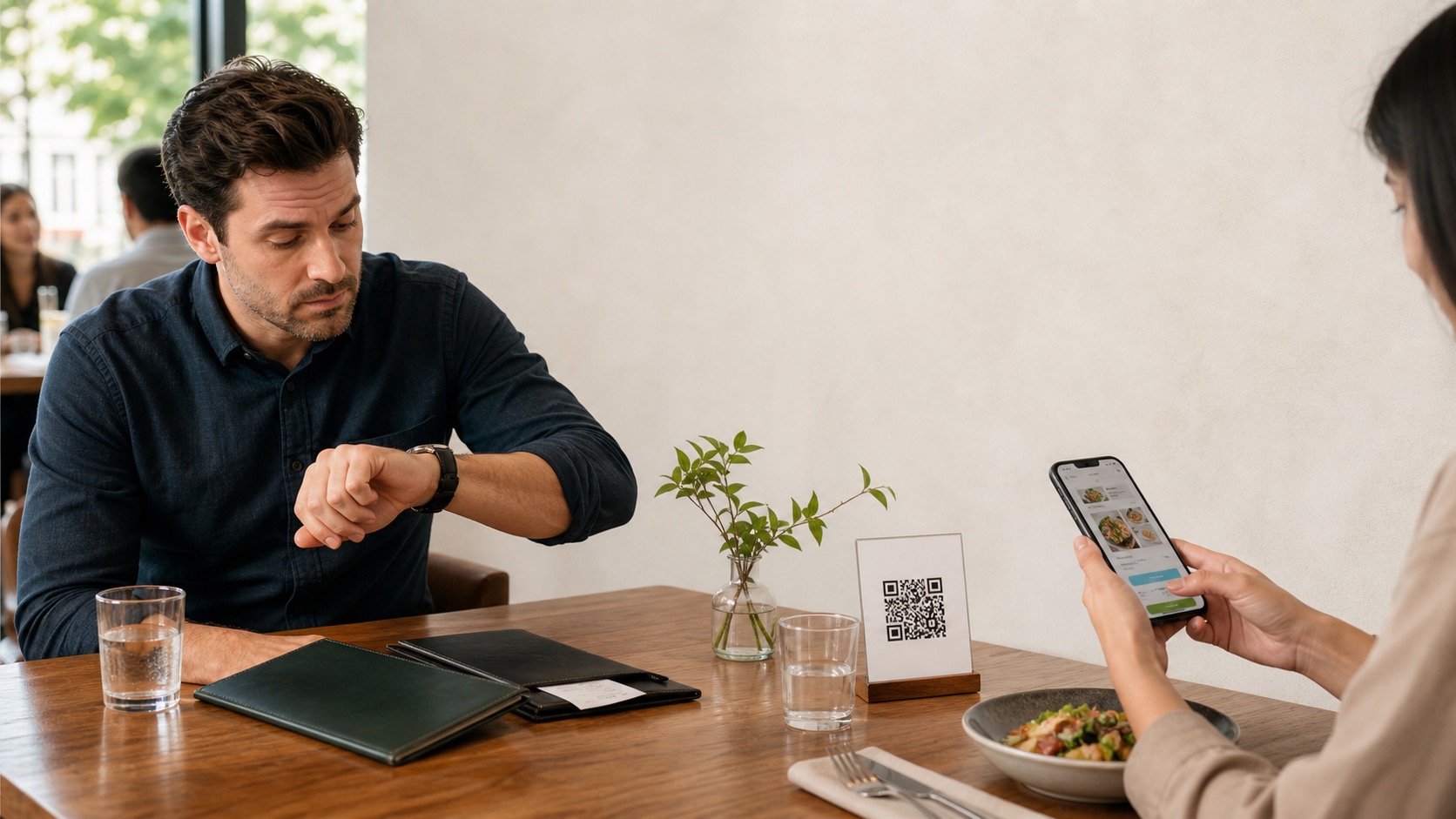
Guest satisfaction does not begin with the first bite. It starts the moment someone sits down and asks a simple question: will someone take care of me? If the answer arrives after several quiet minutes, the whole experience starts late.
There are three moments in a restaurant where waiting hurts most: before the guest gets the menu, before they can place an order, and when they are ready to pay. Each delay can look small on its own. Together, they create the feeling that the venue is moving slower than the guest needs.
Guests do not count processes. They count minutes.
For the team, a delay usually has a practical explanation: a full dining room, a new table, a kitchen printer, a payment at another table, an allergy question, or someone waiting for the card terminal. For the guest, all of that becomes one thing: I have to wait even though I already know what I want.
The frustrating part is that these minutes happen at moments of high intent. The guest wants to open the menu, buy, order another drink, or leave without asking three times for the bill. When the system forces them to wait, the restaurant loses more than speed. It loses buying energy.
Moment 1: waiting for the menu
A printed menu has charm, but operationally it is a constraint. It has to be brought to the table, sometimes collected from another table, and sometimes it lists items that are no longer available. If a guest sits down and does not see the offer for several minutes, the restaurant loses the best moment: fresh attention and appetite.
A QR digital menu is available immediately. The guest sits, scans, and starts exploring the offer on their own. The restaurant does not need someone to walk over only to hand over a menu. The team can step in later where people matter most: recommendations, hospitality, and handling exceptions.
Moment 2: waiting to place an order
This is the most expensive kind of waiting because it happens exactly when the guest is ready to spend. If they have to look around for a waiter, wave, or postpone the decision, some orders disappear. A second drink, dessert, a starter to share — these are bought when the decision is easy and immediate.
ForkTable lets guests place orders from their phones without making staff the only path for every order. The team still controls the room, but it no longer has to be the bottleneck for every tap. Orders arrive clearly, attached to the right table, with less risk that something gets lost during the rush.
Moment 3: waiting for the bill and terminal
At the end of a visit, patience is lowest. The meal is over, the conversation naturally slows down, and someone has a tram, a meeting, or a child waiting at home. If payment means catching staff, waiting for the bill, then waiting for the terminal, and sometimes splitting the amount, the last memory of the venue becomes administrative.
That matters because the final moment strongly affects the judgment of the whole visit. Even good food feels less impressive if leaving the restaurant takes too long. Table-side payment through ForkTable lets guests close the visit when they are ready — without waiting for a terminal or creating tension around splitting the bill.
What this does to customer satisfaction
Waiting in a restaurant is not neutral. Guests begin comparing the delay with the price, the tip, and the promise of the venue. The longer they wait in moments that should be simple, the more chaotic the experience feels, even when the kitchen is doing good work.
- Frustration rises: guests feel they have to fight for attention.
- Control drops: they do not know when they will order or leave.
- Extra sales fall: impulse decisions disappear when guests have to wait.
- Review risk increases: reviews often mention service pace, not only food quality.
ForkTable fixes this without rebuilding the restaurant
The biggest advantage of QR ordering is not that it replaces service. It removes simple blockers from the team's path. The menu, order, and payment do not have to wait for the perfect moment when a waiter is free. Guests can act immediately, while the team focuses on hospitality, quality, and situations that truly need a person.
For restaurants, this means shorter dead time at tables, less rush-hour chaos, better chances for upselling, and a smoother end to each visit. For guests, it means a simpler experience: I see the menu, I order, I pay when I want.
The simple takeaway
Restaurants often invest in interiors, food photography, and campaigns, but lose satisfaction in the most basic service moments. Guests should not have to wait for the chance to buy what they already want to buy. ForkTable shortens that path to one scan — and that is why it has a real impact on customer experience.